
Search for almost any common spice alongside the word “cancer,” and you’ll find a dramatic headline. Turmeric kills cancer cells. Garlic starves tumors. Black pepper makes other compounds more powerful. The wording makes an early laboratory result sound like a treatment you can add at dinner.
That jump is much bigger than it appears.
Researchers do study compounds found in turmeric, garlic, ginger, cinnamon and black pepper. Some of those compounds affect cancer cells in laboratory experiments. That makes them interesting research subjects, but it does not prove that eating the spice prevents cancer, shrinks a tumor or replaces medical treatment.
The most useful way to read this research is to ask where the result came from: a dish of cells, an animal study, an observational study of people’s diets or a controlled trial in people. Those are different stages of evidence, and they cannot answer the same questions.
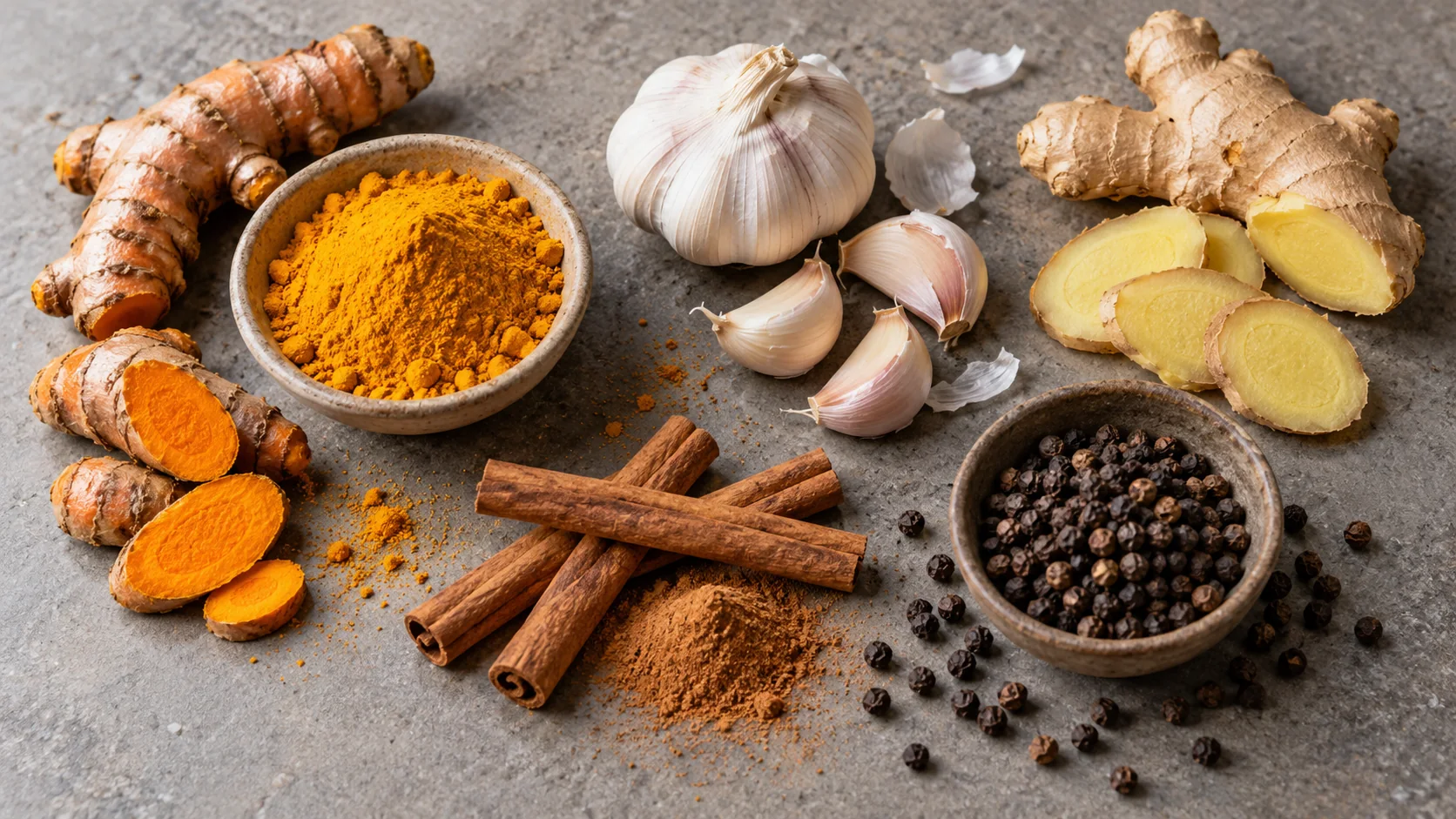
The featured image is an AI-generated illustration of the five culinary spices discussed in this article.
The short answer
No culinary spice has been shown to cure cancer. The National Cancer Institute says there is no proof that a food, herb, supplement or dietary trend can slow cancer, cure it or stop it from returning.
Spices still have a worthwhile place in the kitchen. They make beans, vegetables, whole grains and lean proteins more appealing without requiring much salt or sugar. That supports the kind of varied eating pattern recommended by major cancer organizations. It is a practical food benefit, not a treatment claim.
Why killing cells in a lab is not the same as treating cancer
In a cell study, researchers can place an isolated compound directly onto cancer cells at a chosen concentration. They can then measure what happens to cell growth, signaling or survival. This is a useful way to explore a possible mechanism.
A person is more complicated than a laboratory dish. The digestive system may absorb only a small amount of a compound. The liver may change it quickly. A dose that affects cells in the lab may be impossible or unsafe to reach through food. A compound can also behave differently around healthy tissue, other medications and the immune system.
The NCI’s overview of diet and cancer research makes this distinction clearly: isolated compounds sometimes show anticancer activity in cells or animals, while human studies often produce less definite results.
This does not make laboratory research useless. It tells researchers what may deserve further study. It just is not the final answer.
1. Turmeric and curcumin
Turmeric contains curcuminoids, including curcumin, which gives the spice much of its yellow color. Curcumin has been studied extensively in cells and animals. Early human trials have also examined curcumin products for cancer prevention, treatment support and side effects of treatment.
The results are not strong enough to call curcumin a cancer treatment. The NCI’s evidence review says there is not enough evidence to know whether curcumin products can prevent or treat cancer. The FDA has not approved curcumin as a treatment for cancer or any other medical condition.
There is another detail that online summaries often miss: turmeric used in cooking is not the same as a concentrated curcumin supplement. Products vary in dose and formulation. Some are designed for greater absorption, and the National Center for Complementary and Integrative Health reports that liver damage has occurred in some people taking highly bioavailable curcumin products.
Use turmeric because it brings earthy flavor and color to soup, rice, eggs and vegetables. Do not treat the spice jar as a prescription.
2. Garlic
When garlic is chopped or crushed, chemical reactions form sulfur-containing compounds that researchers have studied in the lab. That biology is interesting, but claims that garlic prevents cancer run ahead of the human evidence.
According to NCCIH’s garlic review, eating garlic does not appear to reduce stomach-cancer risk, and its relationship with colorectal-cancer risk remains uncertain. Garlic supplements can also increase bleeding risk, especially alongside anticoagulants or aspirin.
Normal cooking amounts are a different question from concentrated supplements. Garlic remains an easy way to build flavor into lentils, chicken, vegetables and sauces. Its value in these recipes does not depend on turning it into medicine.
3. Ginger
Ginger is frequently promoted for digestion and nausea. It has also been studied as a possible addition to standard care for nausea and vomiting during chemotherapy. That is supportive care research, not evidence that ginger treats the cancer itself.
The current NCCIH ginger summary describes the chemotherapy-related nausea evidence as uncertain. Some studies report a benefit and others do not. Most research uses supplements rather than the modest amount of ginger added to food.
Fresh or ground ginger still earns its pantry space. It can add warmth to lentil soup, oats, stir-fries and marinades. People taking medicines should check with a clinician before using concentrated ginger products because herbal supplements can interact with drugs.
4. Cinnamon
Cinnamon contains several plant compounds that have been tested in laboratory models. Those experiments are sometimes turned into sweeping claims about blood sugar, inflammation or cancer.
The human evidence is far less certain. NCCIH says research does not clearly support cinnamon as a treatment for any health condition. Cinnamon is generally considered safe in the amounts commonly used to flavor food, but frequent large doses of cassia cinnamon can expose a person to more coumarin, a compound that may be a concern for people with liver disease.
One teaspoon in a two-serving batch of overnight oats is food. A large daily spoonful taken for a medical effect is a different use with a different risk calculation.
5. Black pepper and piperine
Piperine gives black pepper much of its sharp taste. It is often paired with curcumin in supplements because piperine can change how the body handles other compounds.
A small human pharmacokinetic study found that a concentrated piperine dose increased curcumin availability in the bloodstream. That finding is commonly reduced to “black pepper activates turmeric,” which is too broad. The study examined specific supplement-sized doses, not a pinch of pepper in dinner, and it did not test cancer outcomes.
More recent reviews still describe most piperine-and-cancer evidence as preclinical and the clinical evidence as scarce. A 2026 review concluded that standardized dosing, long-term safety data and well-designed clinical trials are still needed. Piperine’s ability to alter absorption is also a reason to be careful with concentrated products: changing drug metabolism is not automatically beneficial.
In cooking, black pepper has a simpler job. It adds heat and balances the flavor of turmeric, vegetables, eggs and meat.
What the stronger diet evidence supports
Cancer risk is not controlled by one ingredient. It is influenced by many factors, including age, genetics, tobacco exposure, alcohol, activity, body weight, infections and the broader pattern of what a person eats.
The American Cancer Society’s prevention guidance emphasizes a consistent eating pattern built around vegetables, whole fruits, legumes and whole grains, along with regular physical activity and maintaining a healthy weight. The World Cancer Research Fund likewise recommends making whole grains, vegetables, fruit and beans a major part of the usual diet.
Spices can make that pattern easier to enjoy. They can turn lentils into a soup you want to reheat, give chicken and broccoli more character, or keep overnight oats from tasting repetitive. That is a realistic reason to use them regularly.
Three practical ways to cook with these spices
- Turmeric red lentil soup with spinach and black pepper uses garlic, turmeric and black pepper in a one-pot meal with plant protein and fiber.
- Turmeric-garlic chicken and vegetable rice bowls pair a spice-forward chicken marinade with rice, roasted vegetables and lemon yogurt sauce.
- Cinnamon-ginger high-protein overnight oats use Greek yogurt, milk, oats, chia seeds and grated apple for a make-ahead breakfast.
These recipes use ordinary culinary amounts. They are meals, not treatment plans.
A sensible line between food and supplements
Seasoning food and taking a concentrated extract are not interchangeable. Supplements may deliver much higher doses, use absorption-enhancing formulations and interact with medication.
If you are receiving cancer treatment, preparing for surgery, taking a blood thinner or managing liver disease, discuss herbal supplements with your doctor or pharmacist. Do not delay medical care or replace prescribed treatment with a food or supplement.
How this article was checked
The evidence was reviewed on October 4, 2026, using current information from the National Cancer Institute, National Center for Complementary and Integrative Health, American Cancer Society, World Cancer Research Fund and linked peer-reviewed studies. The article has not been medically reviewed and does not offer personal treatment advice.
Frequently asked questions
Can turmeric cure cancer?
No. Curcumin has affected cancer cells in laboratory research, and early human studies are continuing, but the NCI says there is not enough evidence to conclude that curcumin prevents or treats cancer.
Does black pepper make turmeric work better?
Piperine can increase curcumin absorption under specific study conditions. That does not prove that adding pepper to a turmeric recipe produces a medical benefit, and it does not turn the combination into a cancer treatment.
Are these spices safe during cancer treatment?
Food amounts may be appropriate for many people, but treatment can change what is safe or tolerable. Concentrated supplements can interact with medication. Ask the oncology team or an oncology dietitian about your situation.
What should I take from the laboratory research?
Treat it as an early clue. Cell studies can help researchers decide what to investigate next. Human trials are needed to learn whether an intervention is safe, reaches the relevant tissue and improves outcomes that matter to patients.
This article provides general nutrition education. It does not diagnose, prevent or treat cancer and is not a substitute for care from a qualified medical professional.
Leave a Reply