
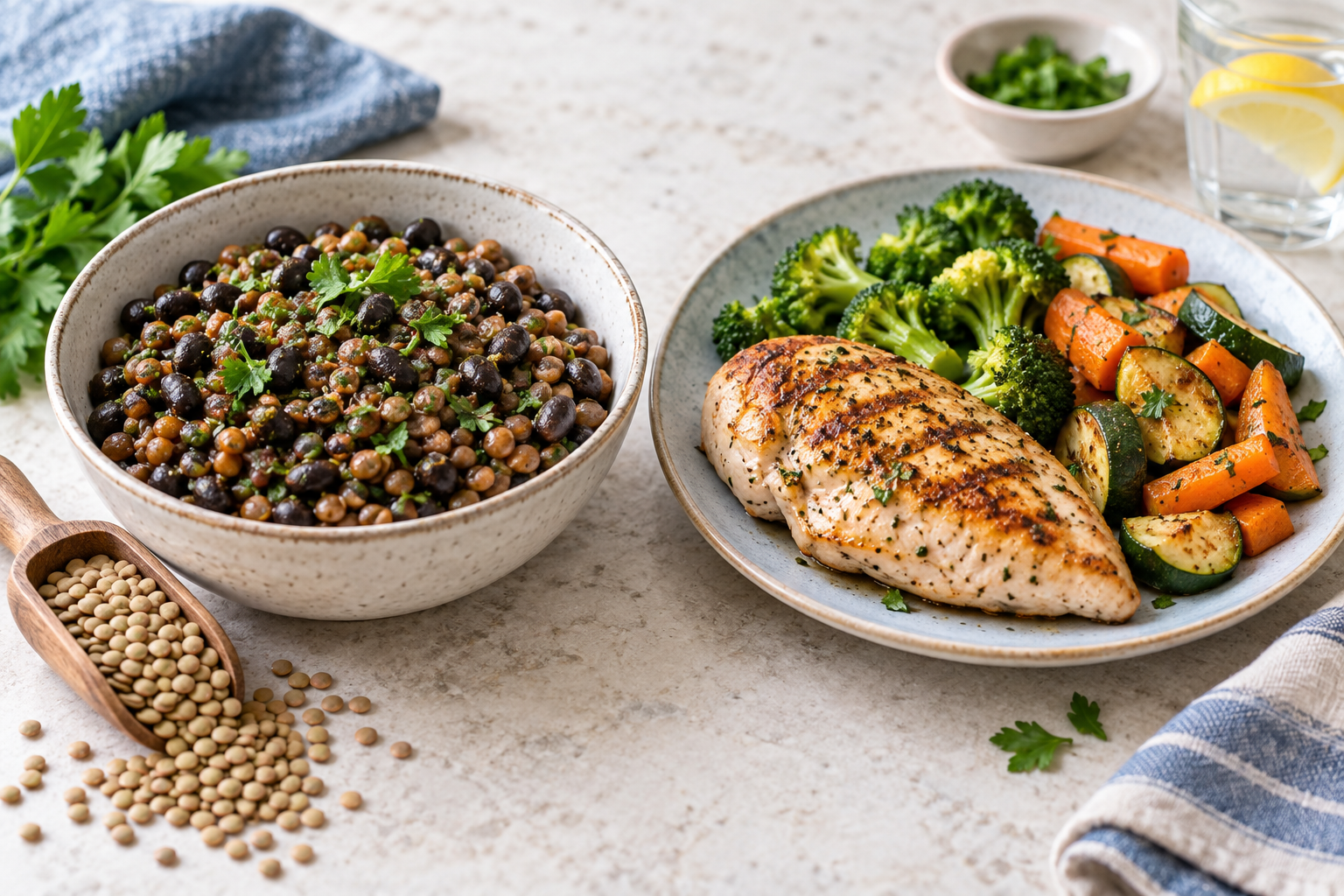
“Which is better, beans or chicken?” depends on what you mean by better. Beans can be an affordable way to add protein and fiber. Chicken packs more protein into fewer calories. Those are different strengths, not a reason one food has to win every meal.
To make the comparison concrete, this article uses a dated grocery-price snapshot from Fitness Fuel Daily’s existing cheap high-protein foods comparison, then puts the price figures beside calorie estimates for the same 25 grams of protein.
Cost and calories for 25 grams of protein
The following figures come from the site’s retailer snapshot checked August 30, 2026. It used current product pages, primarily Walmart, and USDA or product-label nutrition data. Prices are a historical example—not a promise about what you will pay today or in your area.
| Food in the existing comparison | Cost for 25 g protein | Calories for 25 g protein |
|---|---|---|
| Dry pinto beans | about $0.25 | about 405 |
| Split peas | about $0.34 | about 394 |
| Dry lentils | about $0.45 | about 382 |
| Chicken breast | about $0.80 | about 130 |
The calculation standardizes each food to 25 grams of protein so the portions can be compared. It does not mean you would normally eat exactly that amount of each food in one sitting. The price and calorie values also depend on package labels, preparation, and serving assumptions. See the full method and source list.
In that particular snapshot, dry pinto beans cost less per 25 grams of protein than chicken breast. Chicken supplied those 25 grams with fewer calories. Lentils and split peas sat between them on price and calories. Check the current shelf price and package label before using the numbers to plan your own grocery budget.
What the comparison leaves out
Protein-per-dollar and calories-per-protein are useful, but they are not a full measure of a food’s value. Beans and lentils bring fiber and work well in meals such as soups, bowls, and chili. Chicken contributes no dietary fiber, so a chicken meal needs vegetables, beans, fruit, or whole grains for that. Taste, preparation time, storage, dietary preferences, and what you already have at home matter too.
You do not have to choose one camp. Add beans to a chicken bowl, use lentils to stretch a stew, or make a bean-and-rice meal when that fits your budget. The high-protein grocery list has more staple ideas, and the beginner plate guide shows one simple way to build a meal.
Does animal protein build more muscle?
The answer depends on what outcome and population a study measures. A 2025 systematic review of randomized trials found a small pooled difference in muscle-mass changes that favored animal over plant protein. It found no significant difference in muscle strength or physical performance. The included trials used varied protein sources and interventions, so this is not proof that every animal protein outperforms every plant food. Read the review.
A separate 2026 review looked at short-term muscle protein synthesis, a laboratory measure rather than long-term muscle gain. Across 12 studies, estimates slightly favored animal proteins but the difference was small and uncertain; the plant foods were varied, while most animal-protein data came from milk. The authors cautioned against broad generalizations. Read the review.
Those findings do not justify a fixed animal-to-plant ratio for everyone. They also do not make plant foods a poor choice. If you strength train, the basics still include a suitable overall diet, enough total protein for your circumstances, and consistent training. A registered dietitian can help tailor this if you have specific health needs or dietary restrictions.
A budget-minded way to decide
- Compare current prices. Use the price on your shelf, not a national claim or an old web snapshot. Our protein cost worksheet explains the cost-per-25-grams formula.
- Look at the whole meal. Beans add fiber and carbohydrates as well as protein. Chicken is more calorie-efficient for protein in this dataset, but vegetables and a filling side still matter.
- Choose foods you will prepare and eat. Dry beans can be economical but require planning. Canned beans save time. Frozen chicken can be convenient. Which is best depends on your kitchen and routine.
- Mix sources if that helps. A bowl with half beans and half chicken, or lentils served with a smaller meat portion, can combine the strengths of both without following a rigid ratio.
Frequently asked questions
Are beans cheaper than meat for protein?
In the August 30, 2026 snapshot used here, dry pinto beans cost less per 25 grams of protein than chicken breast. Prices vary, and dry lentils were listed at about $0.45—not the same price as pinto beans.
Is plant protein less calorie-efficient?
Some plant staples, such as beans and lentils, provide more calories per 25 grams of protein than chicken breast in the cited comparison. That does not make them unhealthy; it means they bring other nutrients and can be used differently in meals.
Do I need to stop eating meat to eat more plant protein?
No. You can add beans, lentils, peas, tofu, or other plant foods alongside the foods you already enjoy. Small repeatable changes are often easier than all-or-nothing rules.
Bottom line: The dated snapshot shows legumes winning on protein cost and chicken winning on calories per 25 grams. The more useful question is which mix fits your current prices, preferences, meals, and goals.
This article is general nutrition information, not individualized medical advice. See our medical disclaimer.
Sources
- Fitness Fuel Daily. Cheapest High-Protein Foods in 2026: Ranked by Protein Per Dollar. Price snapshot checked Aug. 30, 2026; see that article for method and retailer links.
- Reid-McCann et al. Plant versus animal protein and muscle health. Nutrition Reviews, 2025.
- Mendes et al. Plant versus animal protein and muscle protein synthesis. Journal of the Academy of Nutrition and Dietetics, 2026.
Leave a Reply